Cup Crazy: How a Humble Coffee Mug Became a $500 Status Symbol
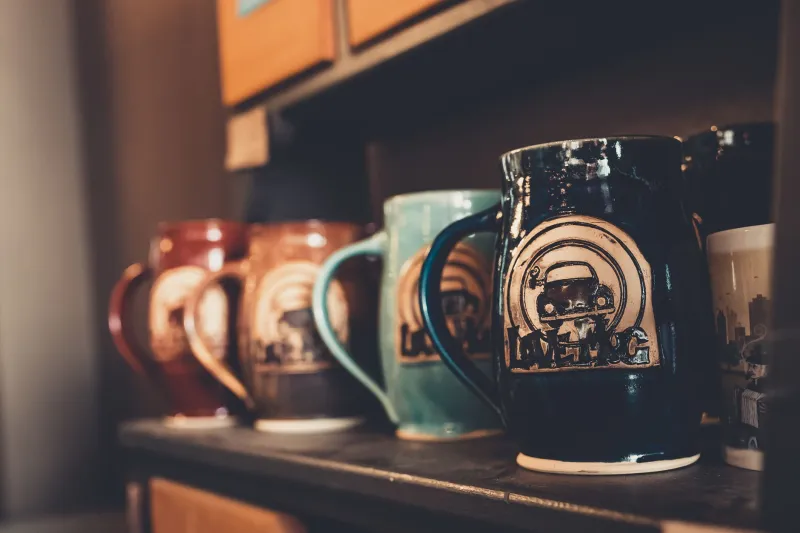
Let's paint a picture. It's 1:47 in the morning. You're not doomscrolling TikTok. You're not stress-eating cereal. No — you're white-knuckling your laptop, watching an eBay auction tick down to its final seconds, prepared to drop $480 on a single cobalt-blue Fiestaware mug from 1938. Your heart is pounding. Your palms are sweating. Your spouse is asleep and blissfully unaware.
This is the glamorous life of the rare kitchenware collector, and it is absolutely unhinged — and somehow completely logical once you understand the subculture.
From Grandma's Cabinet to the Investment Portfolio
Here's the thing about vintage kitchenware: it used to be stuff you inherited from a relative who smelled like lavender and kept hard candy in decorative dishes. Nobody thought twice about it. Then the internet happened, Instagram happened, and suddenly a neon-orange vintage Fiestaware pitcher became the ceramic equivalent of a limited-edition Air Jordan.
Fiestaware, for the uninitiated, is a line of colorful glazed pottery first produced by the Homer Laughlin China Company back in 1936. It went through various eras, color changes, and production runs — and those nuances matter enormously to collectors. A piece in "original red" from the pre-1943 era? That's not just a bowl. That's a grail.
The term "grail" — borrowed wholesale from sneaker culture — refers to the piece a collector would do almost anything to own. It's the white whale. The one that completes the collection. The item that makes you feel briefly, gloriously, like your life has meaning.
The Instagram Effect: When Aesthetics Became Economics
You can't fully explain the mug mania without crediting — or blaming — Instagram and Pinterest. Around 2015, the "cozy kitchen aesthetic" started dominating lifestyle feeds. Suddenly everyone wanted open shelving with artfully arranged vintage ceramics, mismatched yet somehow harmonious, bathed in golden-hour light with a linen dish towel draped just so.
This wasn't accidental. Influencers and interior design accounts began spotlighting vintage pieces — Heath Ceramics, Bennington Potters, Le Creuset in discontinued colorways, and yes, Fiestaware — and the demand exploded practically overnight. What had been $12 thrift store finds became $150 Etsy listings, then $400 eBay sales, then the subject of heated Reddit debates about "fair market value."
Limited-edition drops from modern pottery brands like East Fork or Jono Pandolfi now sell out in minutes, creating the exact same FOMO loop that Supreme and Nike have mastered for decades. Collectors screenshot sold listings like stock traders screenshot charts. Because in many ways, that's exactly what this is.
The Underground Trading Scene Nobody Talks About
Beneath the surface of the casual "vintage kitchen" aesthetic lies a genuinely passionate — occasionally obsessive — collector community operating across Facebook groups, Discord servers, and subreddits with names like r/Fiestaware and r/VintagePottery. These are not casual spaces.
Members post detailed photos with specific lighting to capture glaze variations. They debate whether a piece is "genuine chartreuse" or "slightly off-chartreuse and therefore worth less." They maintain spreadsheets. They have opinions about the Homer Laughlin Company's post-1986 comeback era that they will share at length, unprompted, with great conviction.
And the trading? Fierce. Private sales happen through DMs. People build reputations as reliable sellers or notorious low-ballers. There are community-enforced codes of conduct. Someone once got dragged across three different Facebook groups for misrepresenting a chip as "barely noticeable" in a listing photo. The drama was, by all accounts, spectacular.
So... Is a Mug Actually a Good Investment?
Here's where things get genuinely interesting rather than just charming-weird. Some of this stuff does appreciate. A vintage Fiestaware piece in a discontinued color, in mint condition, can fetch multiples of what someone paid for it a decade ago. Certain limited-edition modern releases from cult pottery brands have doubled in resale value within a year.
But — and this is a big, coffee-stained but — it's not a guaranteed return. Trends shift. That maximalist open-shelf aesthetic might give way to something minimalist and mug-free. Condition matters enormously, and ceramics are, by their nature, fragile. One enthusiastic dishwasher cycle can crater a piece's value.
Most serious collectors will tell you, somewhat sheepishly, that they're not really in it for the money. They're in it because holding a beautifully made piece of pottery from 80 years ago feels like touching something real in a world that increasingly isn't. There's a tactile, emotional satisfaction to it that a stock portfolio simply cannot provide.
That said, they are also absolutely tracking resale values on their phones while pretending to be casual about it.
The $500 Mug and What It Actually Says About Us
Spending $500 on a coffee mug sounds absurd until you remember that people routinely spend $200 on a candle, $400 on sneakers they'll never wear, and $15 on a single cocktail in a city where they can barely afford rent. We are, as a culture, deeply committed to spending money on things that make us feel something — identity, nostalgia, community, beauty.
The rare mug is all of those things wrapped in a glaze finish. It's a connection to the past, a flex for the present, and a conversation starter that beats literally anything you'd find in a generic HomeGoods. When you drink your morning coffee from a 1940s Fiestaware cup in "original ivory," you are participating in history. Dramatic? Sure. But also kind of wonderful.
And if it turns out that mug is worth $800 in five years? Well. You were just ahead of the market, weren't you.
Your financially savvy grandmother would be proud — even if she has absolutely no idea what eBay is.